Each rally begins with a serve
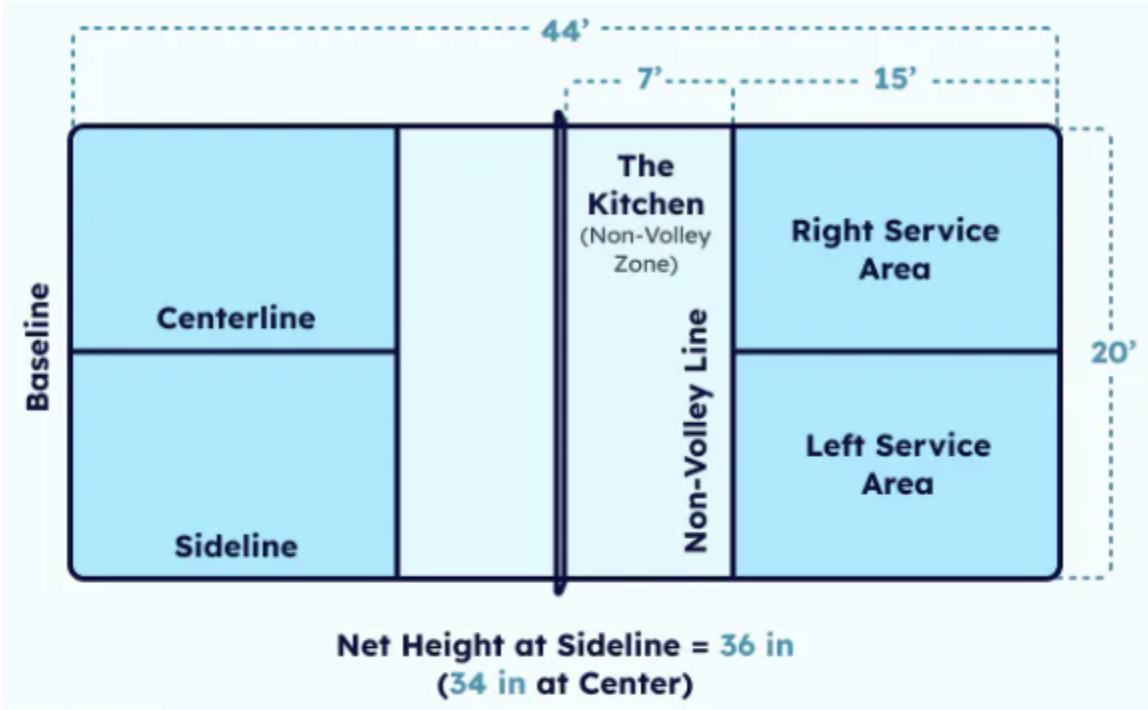
The pickleball game and each rally starts with the serve. The player on the right side of the court, facing their opponents, starts the serve. You serve diagonally to your opponent, into the right or left service area:
The 9 essential rules to start playing
The pickleball game and each rally starts with the serve. The player on the right side of the court, facing their opponents, starts the serve. You serve diagonally to your opponent, into the right or left service area:
A pickleball serve must be hit with an underhand stroke or backhand with contact below the waist. Your arm must move in an upward arc when you strike the ball.
You can either hit the ball out of the air or drop the ball on the ground and hit it. The goal of the pickleball serve is to put the ball in play.
After the serve, gameplay continues until a "fault" is committed. A fault ends the rally. In pickleball, there are three basic types of faults:
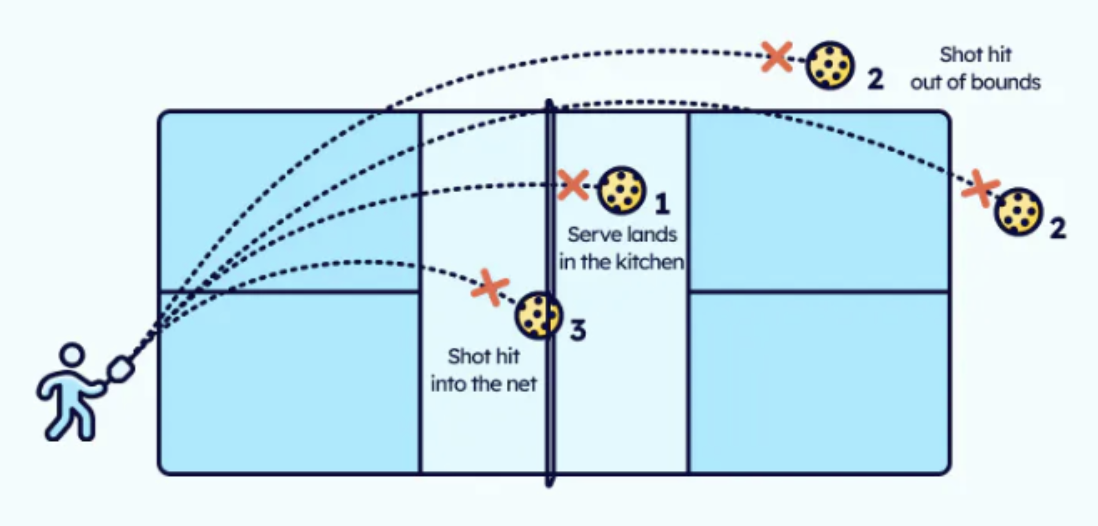
The 7 ft zone on each side marks the non-volley zone, or 'kitchen'. This means you can never hit a volley—a shot hit out of the air—while having any part of your body in the kitchen. Or even on the kitchen line.
And you can't let your momentum carry you into the kitchen after a volley either.
If your opponent hits a short shot landing in the kitchen, you can enter and hit from the kitchen.
Dinks are a defensive shot and one of the most important parts of pickleball strategy. Often your best move after moving into the kitchen to field a dink is to dink right back to your opponent's kitchen.
Before any player can hit a shot out of the air (a volley), the ball must bounce once on each side (known as the 'double bounce rule').
Pro tip: If your partner is serving and you start up at the kitchen, you're in a dangerous position. Why? Because the returning team can hit a shot right at you, and if you react with a volley, that's a fault. You lose the point.
In pickleball, you only win points on your serve, and you continue serving until you lose a rally.
After winning each point on your serve, you switch sides with your partner and serve to the other opponent.
In each turn, both players (in doubles) get the opportunity to serve. And in pickleball scoring, you'll hear players announce three numbers, "Zero, zero… two". What the heck is that third number? It tracks which of the two players on a team has the serve.
Let's say the game is tied at 3-3. If you start the serve (from the right side remember), you'll announce "3-3-1," so everyone knows you are the first player in rotation serving.
If you lose the rally, the ball doesn't go to your opponents. It goes to your teammate who will announce "3-3-2". Then if your partner loses their serve, a 'side out' occurs in which the ball returns to your opponents who again announce, "3-3-1".
Following all the rules above, the game continues until one team gets 11 points. The catch? You have to win by 2.
So if a game's tied 10-10, the next score doesn't win. The game continues past 11-10. This rule can have games on for a long time. You can have ending scores of 12-10, 15-13, or even 21-19.
But these are often the most fun games! 🏆